

In this post
Get the latest insights delivered to your inbox
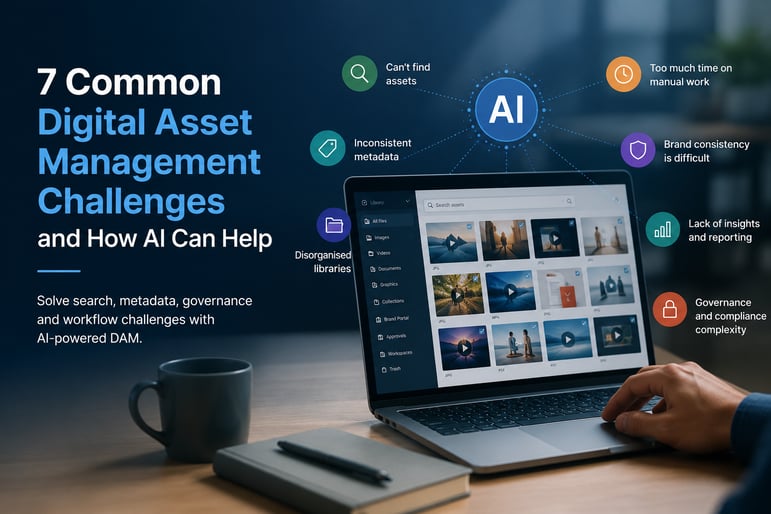
Managing digital assets should make work easier—not create more work.
Yet many organisations still struggle to find files, maintain metadata, manage duplicate content and ensure employees use the latest approved assets. As content libraries continue to grow, these digital asset management challenges become increasingly difficult to solve using manual processes alone.
Artificial intelligence is changing that.
Modern AI-powered digital asset management (DAM) platforms help organisations automate repetitive tasks, improve asset discovery and strengthen governance without replacing the metadata and workflows that keep content organised.
In this article, we'll explore seven of the most common digital asset management challenges and how AI helps solve them.
New to AI in DAM? Start with our guide to AI in Digital Asset Management to understand how artificial intelligence is changing modern DAM platforms.
Why AI Alone Isn't Enough
AI has made enormous progress in recognising images, understanding language and automating repetitive tasks. However, without a structured digital asset management platform, AI quickly becomes disconnected from the information organisations rely on every day.
A modern DAM provides:
- metadata
- permissions
- copyright information
- version control
- audit trails
- integrations
- governance
AI makes these capabilities more efficient—not obsolete.
Challenge 1: Teams Can't Find the Right Assets
One of the most common frustrations is simply finding the correct file.
Employees often waste valuable time searching shared drives, cloud storage platforms or email attachments because assets have been saved inconsistently or tagged differently by different people.
Many organisations don't realise these search problems stem from using shared storage instead of a purpose-built DAM. Learn more in DAM vs SharePoint: Understanding the Difference.
How AI helps you find assets
Modern AI-powered DAM platforms combine several technologies to improve asset discovery.
These include:
- Natural language search
- Reverse image search
- AI-generated Smart Tags
- Facial recognition
- Semantic understanding
Instead of remembering exact filenames or keywords, users can search using everyday language.
For example:
Show me photos from last year's Sydney conference where the CEO is presenting.
This dramatically reduces search time while improving user adoption.
Related reading: How AI Features Are Transforming Digital Asset Management
Challenge 2: Manual Tagging Takes Too Long
Metadata remains the foundation of successful digital asset management, but manually tagging thousands of assets is time-consuming and often inconsistent.
As content libraries grow, maintaining metadata quality becomes increasingly difficult.
How AI helps with tagging
AI can automatically identify:
- objects
- products
- people
- locations
- colours
- activities
and generate Smart Tags during upload.
This reduces repetitive work while improving searchability.
However, AI works best when combined with a well-designed metadata strategy.
Business information such as:
- copyright
- campaign names
- usage rights
- expiry dates
- product codes
still relies on structured metadata created by the organisation.
Related reading: Metadata in digital asset managements
AI can generate metadata automatically, but organisations still need a well-designed metadata framework.
Challenge 3: Content Libraries Become Disorganised
As organisations create more images, videos and documents, libraries quickly become cluttered with duplicate files, inconsistent folder structures and outdated content.
Users lose confidence in the DAM because they no longer know which asset is the latest approved version.
How AI helps to organise your library
AI assists with library organisation by:
- identifying duplicate assets
- recommending metadata
- automatically categorising content
- maintaining consistent organisational structures
New capabilities such as AI Library Assistant also help organisations organise large libraries more efficiently by analysing existing content and suggesting consistent categorisation.
Rather than replacing governance, AI supports it by reducing manual administration.
Challenge 4: Creative Teams Spend Too Much Time on Administration
Marketing and creative teams often spend hours organising files instead of producing content.
Uploading assets, assigning metadata, requesting approvals and preparing files for distribution all consume valuable time.
How AI helps to save time
AI can automate repetitive tasks including:
- metadata suggestions
- content organisation
- approval routing
- duplicate detection
- preparing assets for distribution
Combined with workflow automation, these capabilities help teams focus more on creative work.
Choosing the right platform is just as important as choosing the right AI features. Our guide on How to Choose a Digital Asset Management Solution in Australia explains what to compare.
Challenge 5: Maintaining Brand Consistency Is Difficult
As more teams create and share content, maintaining brand consistency becomes increasingly challenging.
Outdated logos, expired photography and unauthorised assets often continue circulating across the organisation.
How AI helps with brand consistency
AI supports brand governance by helping organisations:
- identify duplicate assets
- surface approved content more easily
- improve search relevance
- maintain consistent metadata
- reduce reliance on outdated files
When combined with permissions and approval workflows, AI helps ensure employees can find and use the right content.
Challenge 6: Organisations Need Better Content Insights
Creating content is only part of the challenge.
Organisations also want to understand:
- Which assets are used most often?
- Which campaigns perform best?
- Which files are never reused?
How AI helps you see the insights
Modern AI-enabled DAM platforms provide insights into asset usage, downloads and engagement.
These analytics help marketing teams:
- identify high-performing content
- reduce unnecessary duplication
- improve future content planning
- maximise return on creative investment
Measuring asset performance also helps organisations understand the return on their DAM investment. Explore our Digital Asset Management Pricing page to see what's included.
Challenge 7: Governance and Compliance Become More Complex
Government agencies, educational institutions and regulated industries often manage sensitive content with strict governance requirements.
AI raises important questions around:
- permissions
- copyright
- privacy
- auditability
- content lifecycle
How AI helps with governance
A well-designed AI-enabled DAM should strengthen governance rather than bypass it.
Look for platforms that combine AI with:
- structured metadata
- permissions
- approval workflows
- audit trails
- digital rights management
AI should help organisations work more efficiently while maintaining control over their digital assets.
As AI becomes more capable, governance also includes transparency and responsible AI use. Read our article on AI Ethics in Digital Asset Management.
What to Look for in an AI-Powered Digital Asset Management Platform
Not all AI capabilities deliver the same value.
When evaluating an AI-enabled DAM, consider whether it offers:
✔ Natural language search
✔ Reverse image search
✔ AI-generated Smart Tags
✔ Facial recognition
✔ Workflow automation
✔ Metadata management
✔ Duplicate detection
✔ Governance controls
✔ Analytics and reporting
The most effective solutions combine AI with strong digital asset management fundamentals rather than treating AI as a standalone feature.
Learn more about our approach to Digital Asset Management in Australia.
FAQ
What are the biggest digital asset management challenges?
Typical DAM challenges include poor searchability, inconsistent metadata, duplicate assets, manual workflows, brand inconsistency, governance and low content reuse.
Can AI solve digital asset management problems?
AI helps organisations solve many common DAM challenges by improving search, automating metadata, organising content libraries and reducing repetitive administrative work.
For a broader overview, read our AI in Digital Asset Management guide.
Does AI replace metadata?
No.
AI improves metadata but doesn't replace governance.
Which industries benefit most?
Government
Education
Manufacturing
Retail
Construction
Healthcare
| Digital asset management challenge | How AI helps |
|---|---|
| Can't find assets | Natural language search and Reverse Image Search |
| Manual tagging | AI-generated Smart Tags |
| Duplicate content | Duplicate Detection |
| Disorganised libraries | AI Library Assistant |
| Slow workflows | Workflow automation |
| Brand inconsistency | AI-assisted governance and approvals |
| Poor content reuse | Analytics and insights |
Conclusion
Digital asset management challenges continue to evolve as organisations create more digital content across more channels.
Artificial intelligence isn't replacing digital asset management—it is making it significantly more effective. By combining AI with structured metadata, governance and workflow automation, organisations can spend less time managing assets and more time using them.
Whether you're looking to improve search, automate tagging or strengthen governance, choosing the right DAM platform is the first step.
Explore how Canto Digital Asset Management helps organisations across Australia and New Zealand solve common digital asset management challenges.
