
Build a Stronger Case for Digital Asset Management
Know you need a better way to manage content, but struggling to get internal approval?
This practical guide helps you identify hidden costs, estimate productivity value, build stakeholder support and present a stronger case for Digital Asset Management.
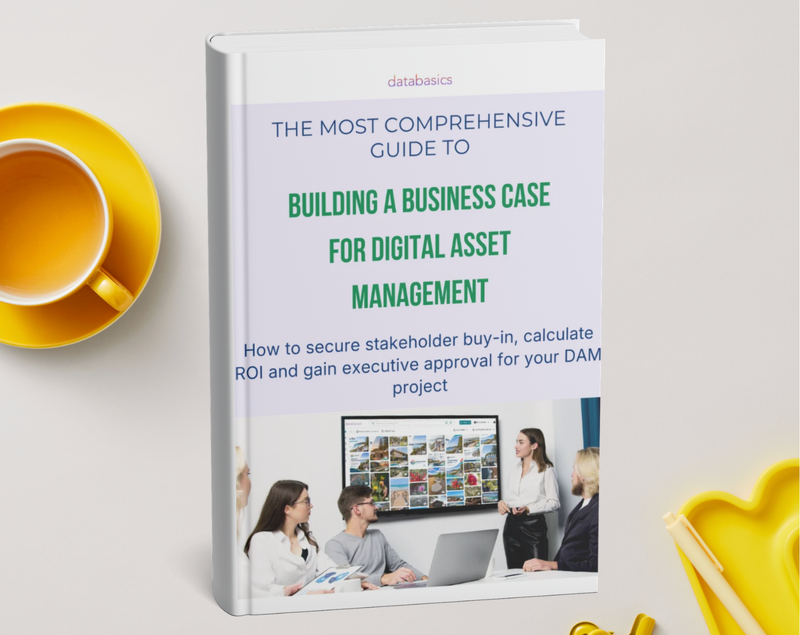
Get your free copy
Complete the form to access:
- The DAM business case framework
- A practical ROI calculation example
- The hidden costs to include in your proposal
- Questions executives are likely to ask
- Stakeholder and implementation checklists
- Guidance for presenting the case to finance, IT and leadership
This guide is designed specifically for Australian and New Zealand organisations navigating and researching how to choose a DAM in Australia and New Zealand.
You know there is a problem. But how do you prove it?
Poor content management rarely appears as one large expense.
Instead, the cost is spread across hundreds of everyday tasks:
- Employees searching across shared drives, SharePoint and cloud folders
- Marketing teams responding to repeated asset requests
- Designers recreating content that already exists
- Departments using outdated logos, images or collateral
- Campaigns delayed while teams wait for files and approvals
- Copyright, consent and compliance information managed manually
These issues may feel operational, but together they affect productivity, marketing performance, governance and organisational risk.
A strong DAM business case turns these everyday frustrations into clear business outcomes that decision-makers can understand.
Who this guide is for
This guide is designed for marketing, communications, brand and content leaders who recognise that their current approach is no longer working—but need broader organisational support before investing in a DAM.
It will be particularly useful if:
- Your digital assets are spread across multiple systems
- Employees struggle to find the latest approved content
- Teams repeatedly recreate assets
- Brand governance is becoming difficult
- You need to justify the cost of a DAM
- IT believes SharePoint or shared drives should be enough
- Finance wants clearer evidence of business value
- Your project has stalled because no one owns the internal case
- You need to align marketing, IT, procurement and executive stakeholders
Typical readers
- Marketing Managers
- Heads of Marketing
- Communications Managers
- Brand Managers
- Digital Marketing Managers
- Content and Creative Operations leads
- DAM project leads
- IT and digital transformation stakeholders
What you'll learn
Identify the real business problem
Move beyond “we need a better place to store files” and define the operational, governance and strategic challenges your organisation needs to solve.
Calculate potential productivity value
Estimate the value of time spent searching for assets, recreating content and managing inefficient workflows—without overstating guaranteed financial savings.
Build stakeholder support
Understand what marketing, IT, finance, procurement and executive sponsors need from the proposal.
Answer executive questions
Prepare credible responses to questions such as:
- Why do we need a DAM now?
- Why can’t we continue using SharePoint?
- Will employees actually use it?
- How will we measure success?
- What happens if we do nothing?
Avoid common business case mistakes
Learn why projects lose momentum when they focus too heavily on features, underestimate adoption or begin vendor selection before agreeing on business requirements.
Prepare for implementation
Connect the investment case to governance, metadata, migration, training and long-term adoption.
Make a credible case for DAM ROI
Executives and finance teams will want to understand the potential value of the investment.
The guide shows you how to estimate:
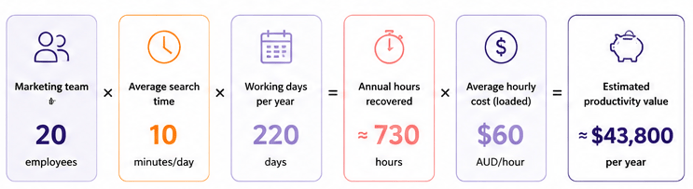
- Time spent searching for assets
- Productive hours that could be reclaimed
- The value of reduced duplication
- Better reuse of existing photography and creative work
- Reduced administration and asset requests
- Faster campaign delivery
- Governance and compliance benefits
The aim is not to promise a guaranteed reduction in operating costs.
It is to demonstrate how much productive capacity is currently being absorbed by inefficient content management.
See how productivity savings translate into real value in this ROI Calculation Example:
Written for Australian and New Zealand organisations
Global DAM content often overlooks the realities of local procurement, governance and support.
This guide includes considerations relevant to organisations across Australia and New Zealand, including:
- Data hosting and security
- Copyright and asset usage rights
- Consent management
- Accessibility and public-sector governance
- Internal procurement requirements
- Local onboarding, training and support
- Working across distributed teams and external partners
The examples are relevant to sectors including:
- Local and state government
- Higher education
- Manufacturing
- Construction and infrastructure
- Retail
- Travel and tourism
- Non-profit organisations
What's inside
- Why every DAM project needs a business case
- How to recognise when your organisation is ready
- The hidden cost of poor content management
- The business benefits of Digital Asset Management
- How to calculate potential ROI
- Questions executives will ask
- Industry-specific business case considerations
- Common mistakes to avoid
- The DAM approval journey
- Executive checklist and next steps
Turn content frustration into a business case for change
You may already know that your current systems and processes are no longer enough.
This guide will help you explain why the problem matters, what better content management could deliver and how to build support for the next step.