

Digital asset management (DAM) software is designed to make managing content easier. Modern platforms can be quick to set up, intuitive to use and far simpler to manage than the DAM systems organisations were implementing a decade ago.
So where do things still go wrong?
Usually, it isn't the technology.
A DAM can work perfectly well and still deliver less value than it could because of a few decisions around objectives, processes, metadata, ownership or ongoing management.
More than a decade ago, databasics documented some of the most common mistakes organisations made with DAM. We've revisited those lessons in the context of today's technology, including AI-powered search, modern SaaS platforms and increasingly distributed content teams.
Some things have changed considerably. Others haven't.
The good news is that avoiding these common DAM mistakes does not mean introducing complicated governance or creating more administration. A small marketing team and a large government department do not need the same operating model.
The level of structure should match the size, risk and complexity of the organisation.
Here are 10 common DAM mistakes and practical ways to avoid them and get more value from your DAM.
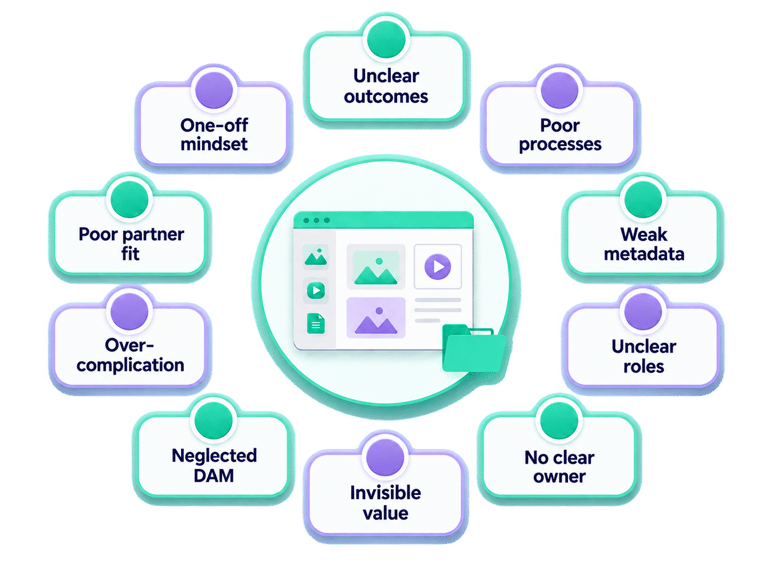
The 10 common DAM mistakes
- Starting without clear business outcomes
- Expecting technology to fix poor processes
- Assuming AI makes metadata unnecessary
- Making DAM solely a Marketing or IT responsibility
- Having shared responsibility but no clear owner
- Failing to communicate DAM’s value
- Letting a successful DAM become invisible infrastructure
- Overcomplicating configuration and customisation
- Evaluating the software but not the implementation relationship
- Treating DAM as a one-off purchase

The best way to avoid these mistakes is to focus on the positive practices that make DAM easier to use, easier to manage and more valuable over time.
We focus on practical recommendations to avoid these common DAM mistakes .
1. Start with clear business outcomes
Before worrying about configuration, decide what you actually want DAM to improve.
That might sound obvious, but “we need somewhere central for our assets” is not really a business outcome.
More useful objectives might include:
- reducing the time people spend looking for approved assets
- increasing reuse of existing content
- reducing duplicate content creation
- allowing other teams to find approved content without asking Marketing
- improving brand consistency
- managing rights and consent more reliably
- reducing reliance on shared drives and individual file requests
Write the objectives down and decide how you will know whether things have improved.
You don't need a complicated measurement programme. Start with a few practical baselines.
How long does it currently take someone to find an approved image? How many asset requests does Marketing receive each week? How often is existing content recreated because nobody knows it already exists?
The goal is to measure whether DAM is improving the work, not simply running.
If you're still defining the commercial case for DAM, our guide to building a business case for digital asset management looks at how to connect DAM features to measurable organisational outcomes.
The mistake this avoids: Starting with vague objectives, a technology-led scope and no clear definition of success.
2. Get the process clear before configuring the technology
A DAM can make a good process considerably easier. It can also reproduce a confusing process inside a new system.
If nobody knows who approves an asset today, adding an approval workflow won't answer that question for you.
Before getting too deep into configuration, identify the processes that matter:
- Who uploads assets?
- Who decides whether content is approved?
- Who can change permissions?
- Who manages the library?
- What happens when an asset expires?
- How should external agencies or partners access content?
For a smaller organisation, the answers might be very simple and several responsibilities might sit with one person.
More complex organisations may need clearer involvement from Marketing, IT, privacy, legal or records teams.
The objective is not to document every conceivable workflow.
It is to make sure the DAM supports how people actually need to work.
If you're looking for the practical steps involved after selecting a platform, our DAM implementation guide covers governance, metadata, migration, integrations, onboarding and continuous improvement in more detail.
The mistake this avoids: Expecting technology to repair unclear workflows and responsibilities.
3. Use AI and metadata for what each does best
One of the biggest changes in DAM over the past few years is AI-powered discovery.
Visual search can now surface assets based on what appears within an image, even when someone never manually entered those exact keywords.
A user might search for:
- “two students walking on a university campus”
- “a student using a wheelchair”
- “people working on a construction site”
and discover content that previously would have been difficult or impossible to find.
That can dramatically reduce the amount of manual tagging required.
But it does not make metadata irrelevant.
AI can help determine what an asset looks like.
It cannot reliably know:
- whether the organisation has permission to use it
- whether consent has been obtained
- where the asset is approved for use
- who owns it
- when a licence expires
- whether it is the approved version
- whether usage is restricted
Those are business facts, not visual characteristics.
The best approach is therefore not “AI or metadata”. It is both.
Keep human-defined metadata focused on the information people and systems genuinely need, and let AI reduce the burden of describing what it can already understand visually.
Our article on DAM governance and metadata looks more closely at building useful structure without creating unnecessary administration.
You can also explore the wider role of AI in digital asset management, including visual search, tagging and content organisation.
The mistake this avoids: Having too little useful metadata — or assuming AI removes the need for business metadata altogether.
.png?width=600&height=450&name=ChatGPT%20Image%20Aug%2031%2c%202026%2c%2010_59_43%20AM%20(3).png)
4. Give Marketing and IT clear, different responsibilities
Who should own DAM: Marketing or IT?
In many organisations, the answer is not simply one or the other.
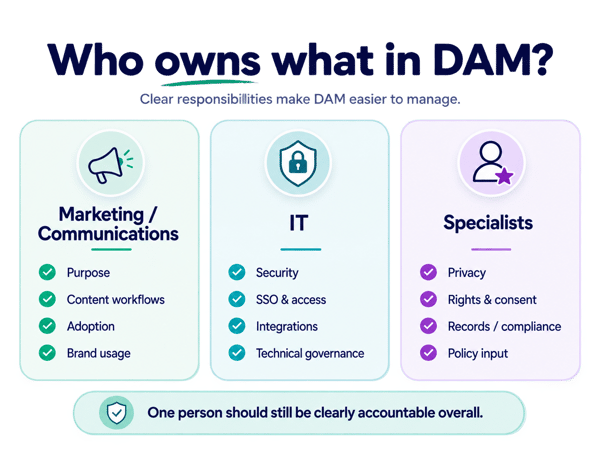
Marketing and Communications generally understand:
- the content
- users
- brand requirements
- content workflows
- how people need to find and distribute assets
IT generally supports areas such as:
- security
- system architecture
- SSO
- integrations
- technical governance
Other specialists may need to contribute where privacy, consent, records management, compliance or data requirements intersect with DAM.
That doesn't mean every DAM needs a large cross-functional committee.
For a smaller team, Marketing might manage the DAM day to day and involve IT only when required.
For an enterprise or public-sector organisation, responsibilities may need to be more formally defined.
The key is clarity.
If you're deciding who needs to be involved, our guide to DAM stakeholders looks at the roles Marketing, creative teams, IT and other stakeholders can play.
The mistake this avoids: Leaving IT too late, expecting IT to own content strategy, or having no clear understanding of who owns which part of the outcome.
5. Make sure one person is accountable
Shared responsibility can be valuable. Shared accountability is harder.
If everybody has some responsibility for DAM but nobody ultimately owns it, small issues tend to accumulate.
Metadata becomes inconsistent. Old content remains active. New users don't get properly introduced to the system. Permissions go unchecked. Useful improvements don't get prioritised.
That doesn't mean every organisation needs a full-time DAM Manager.
A small team might simply nominate one person who has DAM as part of their existing role.
A large organisation with thousands of assets, multiple teams and significant compliance requirements may need dedicated DAM resources.
Good DAM governance should be proportional to complexity.
What matters is that there is one identifiable person who notices when something needs attention and can coordinate the people who need to act.
The mistake this avoids: An unsupported administrator trying to manage everything alone — or a committee where everybody is involved but nobody is accountable.
6. Make the value of DAM visible
There is an interesting problem with DAM when it works well. People stop noticing it.
Before DAM, Marketing might regularly hear:
“Can you send me the latest logo?”
“Do we have a photo of this product?”
“Which presentation is approved?”
“Can I use this image?”
Once employees can find approved content themselves, those requests disappear.
That's exactly what you want.
But it can also make the value of DAM less visible.
A well-used DAM may be quietly delivering:
- fewer interruptions for Marketing
- faster access to approved content
- greater reuse of existing assets
- less duplicate content creation
- fewer unnecessary purchases of licensed imagery
- stronger brand consistency
- easier distribution to other teams and partners
- lower risk around rights and consent
In other words, some of the strongest DAM benefits are the taks people no longer have to do.
This is why it is useful to return to the outcomes you identified at the beginning and report on them.
Useful measures might include:
- average time to find an asset
- content reuse
- self-service access
- user adoption
- administrative effort
- approved-content usage
- rights and consent coverage
You don't need to measure everything. Choose the indicators that matter to your organisation.
The mistake this avoids: Failing to understand or communicate DAM's value once the initial implementation project is over.
7. Don't let a successful DAM become invisible infrastructure
This follows directly from the previous point. A good DAM can become part of the furniture.
People find what they need. Portals work. Marketing receives fewer requests. Nobody complains.
And because nobody is complaining, attention moves elsewhere.
Meanwhile:
- new teams join
- content volumes increase
- metadata requirements change
- permissions become outdated
- new integrations become useful
- new DAM capabilities become available
- working practices evolve
None of this means DAM requires constant intervention. It does benefit from occasional attention.
For a smaller organisation that may simply mean an annual review.
A more complex organisation may choose quarterly health checks or regular governance reviews.
Ask:
- Are people still finding what they need?
- Is our metadata still useful?
- Are permissions appropriate?
- Are old or expired assets being managed?
- Are there teams that would benefit from better self-service?
- Are we using the features that could genuinely make people's jobs easier?
Regularly sharing evidence of DAM value also helps ensure the system remains supported rather than quietly becoming an overlooked operational cost.
The mistake this avoids: Allowing useful infrastructure to become invisible and gradually underinvested in.
8. Keep configuration as simple as you reasonably can
It can be tempting to reproduce every existing folder, exception and workflow inside a new DAM.
Resist that temptation.
Modern SaaS DAM platforms already provide a great deal of functionality through standard configuration. Start there. Configure first.
Integrate where there is clear business value.
Customise only when there is a genuine requirement that cannot reasonably be handled another way.
Before introducing extra complexity, ask:
- What business value will this deliver?
- Who will maintain it?
- Will it remain reliable as the platform changes?
- Who owns it long term?
- Is the lifecycle cost worth the benefit?
Every customisation creates some form of maintenance obligation.
That doesn't make customisation wrong. It simply means it should be deliberate.
The mistake this avoids: Choosing the wrong balance between standardisation and customisation and making an otherwise straightforward DAM unnecessarily complex.
9. Evaluate the relationship, not just the software
DAM evaluations naturally focus on the platform.
Search.
AI.
Portals.
Integrations.
Permissions.
Storage.
All of those things matter.
But when you select a DAM, you are often also selecting the organisation that will help you implement, support and improve it.
Look beyond the product demonstration.
Consider:
- Does the provider have experience with organisations like yours?
- Can they provide relevant customer references?
- What does onboarding actually include?
- Who will help with configuration and migration?
- What support is available after go-live?
- Is support accessible during your working hours?
- Can they help with integrations?
- Do they understand relevant security and compliance requirements?
- Do they understand your local operating environment?
- Will expertise still be available when your needs change?
For Australian and New Zealand organisations in particular, local implementation experience and time-zone-aligned support can make what should be a straightforward implementation much easier.
If you're currently comparing platforms, our guide to DAM vendors available in Australia looks at some of the options and the factors worth comparing beyond a feature list.
And if you're earlier in the buying process, our guide to choosing a DAM in Australia and New Zealand provides a broader evaluation framework.
The mistake this avoids: Choosing a platform based on the software alone without considering implementation capability, support and long-term fit.
10. Treat go-live as the beginning, not the end
A DAM should not require endless consultancy or constant administration. But it isn't completely static either.
Content changes Teams change AI capabilities evolve Rights expire New channels appear Integrations change New employees arrive.
Organisations that continue getting value from DAM tend to make small improvements over time.
That might involve:
- refining metadata
- training new users
- introducing a new portal
- reviewing permissions
- archiving old content
- improving an integration
- extending DAM to another team
- making use of a useful new feature
- reviewing adoption and usage
For many organisations these are relatively small activities.
The point is not that DAM needs constant work.
It's that small amounts of ongoing attention protect the value of the original investment.
For more practical implementation advice, see our digital asset management implementation tips.
The mistake this avoids: Treating DAM as a one-off software purchase rather than something that should continue supporting the organisation as its needs evolve.
How much DAM governance do you actually need?
There isn't one correct governance model for every organisation.
A small Marketing team might need little more than:
- one clear DAM owner
- a sensible library structure
- a few useful metadata fields
- simple upload and approval rules
- basic user training
- an occasional review
A large government department, university or enterprise may need considerably more structure because it is managing more users, more assets, more integrations and greater privacy, security or compliance risk.
Both approaches can represent good DAM governance. The difference is scale.
The aim isn't to make DAM harder to manage.
It's to introduce just enough structure to make the platform easier to use and the content within it easier to trust.
Why these DAM mistakes are connected
None of these issues really exists in isolation. Unclear objectives make it harder to know what success looks like. That can make ownership less clear.
Weak ownership can lead to inconsistent metadata.
Poor metadata reduces trust and findability.
If people struggle to find content they trust, adoption suffers. When adoption is poor, DAM's value becomes harder to demonstrate.
And when value is invisible, the organisation is less likely to invest time in keeping the DAM useful.
The reverse is also true.
Clear outcomes create focus.
Simple ownership creates accountability.
Useful metadata improves discovery.
Better discovery encourages reuse.
Good experiences increase adoption.
And visible results help maintain support.
The technology enables all of this. It shouldn't make it more complicated.
Successful DAM should make work easier
The purpose of digital asset management is not to create another administrative burden.
It is to make it easier for people to find, manage, share and reuse the content the organisation already owns.
Modern DAM technology has removed many of the technical challenges organisations dealt with in the past. AI is making content discovery easier again.
But technology still needs a small amount of context around it: what the organisation wants to achieve, who owns what, which information matters and how success will be recognised.
Get those things right and DAM should fade into the background for the right reason:
because people can simply find what they need and get on with their work.
Successful DAM is sustained, not simply launched.
Frequently asked questions about common DAM mistakes
What is the most common DAM mistake?
One of the most common DAM mistakes is starting with the software rather than the business problem. Clear objectives make it easier to design metadata, assign ownership, measure adoption and demonstrate whether DAM is actually improving the way people work.
Does DAM need a lot of governance?
Not necessarily. DAM governance should match the size and complexity of the organisation. A small team may only need one owner, a few agreed rules and useful metadata. Larger organisations with more users, integrations and compliance requirements may need a more structured approach.
Does AI mean we need less DAM metadata?
AI can significantly reduce the need to manually describe the visual content of assets, but business metadata remains important. Information such as rights, consent, ownership, expiry and permitted usage generally needs to be defined and governed by the organisation.
Who should own a DAM?
DAM is often operationally owned by Marketing or Communications, with IT supporting security, SSO, integrations and technical requirements. The exact model varies, but it is useful to have one clearly accountable person coordinating the DAM.
Does a DAM need ongoing management after implementation?
Yes, but this does not necessarily mean significant ongoing administration. Periodic reviews of metadata, users, permissions, assets and workflows can help ensure the DAM continues to reflect how the organisation works and delivers value over time.
Planning a DAM implementation or reviewing an existing system?
