


Managing thousands or even millions of digital images has become a challenge for many organisations. Marketing teams, universities, government departments and brands produce vast amounts of visual content every year, making it difficult to organise and locate the right assets when they are needed.
This is where AI visual search and image recognition in digital asset management (DAM) are transforming how organisations manage their digital libraries. Modern DAM platforms use artificial intelligence to automatically analyse images, identify visual elements, and help users find assets instantly—even without manual tags or metadata.
In this article, we explore how AI-powered image recognition works in digital asset management and how modern features such as AI visual search, reverse image recognition and automated tagging help organisations manage their growing content libraries more efficiently.
What is Image Recognition in Digital Asset Management?
Image recognition is a form of artificial intelligence that allows software to analyse and understand the visual content of an image. Using machine learning and computer vision technology, a system can identify objects, scenes, colours, text and even people within an image.
When integrated into a digital asset management system, image recognition helps automatically categorise and organise visual content. Instead of manually tagging every image, the DAM platform can analyse new uploads and generate metadata automatically.
For organisations managing large image libraries, this reduces manual work and makes digital assets easier to find.
Common elements AI image recognition can detect include:
- objects such as buildings, vehicles or products
- environments like beaches, offices or cities
- activities such as meetings, sports or travel
- brand elements including logos or products
- people through facial recognition technology
By analysing visual elements within images, DAM systems can significantly improve how assets are indexed and retrieved.
Why Image Recognition Matters for Modern Content Libraries
The amount of visual content created by organisations has grown dramatically over the past decade. Marketing teams now produce content for websites, social media, advertising campaigns, internal communications and more.
Without effective organisation tools, these files quickly become difficult to manage.
Traditional DAM systems rely heavily on manual metadata, where users add tags, descriptions and keywords to each asset. While metadata remains important, it can be time-consuming and inconsistent.
Image recognition and AI search capabilities solve this problem by helping systems understand the visual content of files automatically.
This provides several advantages:
- faster asset discovery
- reduced manual tagging effort
- improved search accuracy
- better reuse of existing content
- easier management of large media libraries
For organisations dealing with thousands or millions of assets, AI-powered DAM features can significantly improve efficiency.
AI Visual Search: Finding Assets Without Metadata
One of the most powerful innovations in digital asset management is AI visual search.
Instead of relying only on keywords or filenames, visual search allows users to describe what they are looking for in natural language.
For example, a user could search for:
- “students studying in a library”
- “construction workers wearing safety helmets”
- “team meeting in an office”
The DAM platform analyses the visual content of images and returns assets that match the description.
Canto DAM's AI Visual Search uses advanced image recognition technology to understand scenes, objects and activities within images. This allows users to locate assets even when they do not know the exact filename or metadata.
This capability is particularly useful for large organisations where thousands of images may be stored in the DAM system.
How does AI Visual search work?
When AI Visual Search is enabled it let's you use natural language prompts to discover images in your library.
.png?width=600&height=600&name=AIVS%20manufacturing%20(1).png)
Reverse Image Search in DAM
Another powerful feature enabled by AI is reverse image search.
Instead of typing a search query, users can upload an image to find visually similar assets within the digital asset library.
For example, a marketing team might upload a product image to locate:
- alternative angles of the same product
- images from previous campaigns
- visually similar photos that match a brand style
Reverse image recognition is useful for maintaining visual consistency across marketing campaigns and improving asset reuse.
By finding similar images quickly, teams can reduce duplicate content creation and maximise the value of existing assets.
How does reverse image search work?
Select an image or upload a new image and click Find Visually Similar. This capability allows you to locate visually similar assets, duplicates or specific video frames.

AI-Powered Smart Tags and Automated Metadata
Many modern DAM systems also use AI to automatically generate metadata through automated tagging.
When new images are uploaded, the AI analyses their visual content and assigns relevant keywords. These tags may include objects, environments, activities or other visual elements detected in the image.
Canto’s Smart Tags feature automatically applies descriptive keywords to images, making them searchable without manual tagging.
This automation improves search accuracy and reduces the time required to organise digital assets. Instead of manually tagging thousands of files, organisations can rely on AI to create the initial metadata and then refine it where necessary.
How does auto-tagging work?
Select one or more assets from your collection, hit Generate Smart Tags in your tool box.
The tags are generated. Review, edit or delete tags.
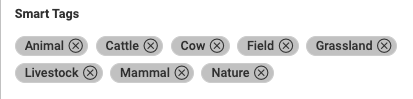
And you’re done.
Facial Recognition in Digital Asset Management
Facial recognition is another AI capability that can enhance digital asset management.
This technology identifies and groups images containing specific individuals. Once a person has been identified in the system, the DAM can automatically locate other images where that person appears.
Facial recognition can be particularly useful for organisations such as:
- universities managing event photography
- government departments archiving public events
- marketing teams organising brand ambassador images
- sports organisations managing athlete photography
By automatically identifying people in images, DAM systems make it easier to manage large photo libraries and locate specific individuals quickly.
How does facial recognition work?
Facial recognition lets you tag faces in images and videos, once tagged, all images of a person can be searched throughout the library - in images and videos. Read our blog Facial Recognition in Canto Best Practices for more info.
Benefits of AI Image Recognition for Marketing Teams
For marketing and communications teams, AI-powered DAM features can significantly improve productivity and content management.
Some of the key benefits include:
Faster content discovery
AI search tools help users locate images instantly without relying solely on manual metadata.
Improved asset reuse
Visual search and reverse image recognition help teams rediscover valuable content that may otherwise be forgotten.
Reduced manual workload
Automated tagging reduces the time required to organise digital assets.
Better brand consistency
Teams can quickly find visually similar images to maintain a consistent look across campaigns.
Scalable content management
As organisations create more digital content, AI-powered DAM systems make it easier to manage growing asset libraries.
How Canto Uses AI in Digital Asset Management
Canto integrates several AI-powered capabilities designed to improve asset organisation and discovery.
These features include:
- AI Visual Search that allows natural-language search for images and videos
- Reverse image recognition for finding visually similar assets
- Smart Tags that automatically generate metadata for images
- Facial recognition for identifying individuals in photo libraries
Together, these capabilities help organisations manage large volumes of digital assets more efficiently while improving search accuracy and reducing manual work.
For organisations dealing with rapidly expanding visual libraries, AI-powered digital asset management provides a scalable solution for organising, discovering and reusing content.
